
20 december, 2022 | Auteur: Ismail Einashe | Trefwoord: italie
The African migrants accused of people smuggling in Italy
Hundreds of African migrants, some of them minors, are currently being held in Italian prisons. They are convicted of smuggling people in boats across the Mediterranean. A Gambian who came to Italy in 2015 aged 17 lived through this nightmare.
When the 17-year-old Gambian migrant landed in Sicily in early 2015, he thought he would be sent to a migrant reception centre for minors. He had arrived on the Italian island at the height of the so-called ‘migrant crisis’ and had survived the dangerous boat journey across the Mediterranean from Libya to Italy.
However, once he disembarked, he was escorted by officials and taken into a police station in Agrigento, a port town in the south of Sicily.
Lamin – whose name has been changed to protect his identity – was shocked and in tears. He told the police: “You cannot put me in handcuffs, what is the meaning of this.”
He could not believe what had happened to him – this is not the Europe he had imagined before he embarked on a dangerous journey from The Gambia in search of a better life.
He would go on to spend a year in an adult prison on people smuggling charges even though he was a minor.
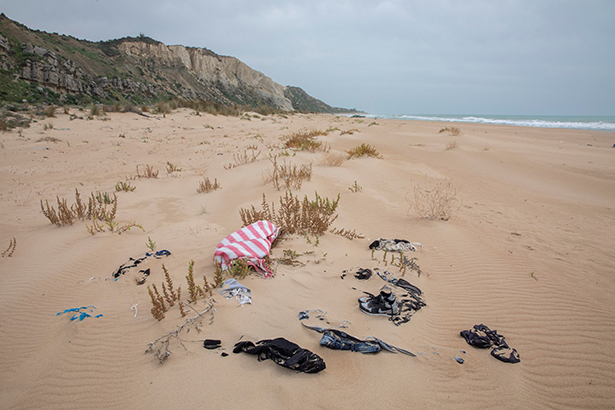
Lamin’s story is not unique – in the last decade more than 2,500 people have been arrested in Italy on people smuggling charges, according to a recent report by Palermo-based non-governmental organisation Arci Porco Rosso.
People arrested for smuggling, like Lamin, are charged with aiding and abetting illegal immigration, a crime punishable by up to 15 years in prison and millions of Euros in fines.
Maria Giulia Fava, the paralegal and co-author of the report, complains that charges are being brought on the basis of extremely weak evidence, unreliable witnesses and court hearings are not open and there is a lack of adequate access to legal defence. She accuses Italy of using people-smuggling laws to criminalise migrants in an attempt to scapegoat them over immigration levels.
In Lamin’s case, his name was called out by officials on the Italian coastguard boat that was transferring him and other migrants from Lampedusa, where they had first landed in Italy in early 2015.
When Lamin’s boat arrived in Agrigento, he was immediately escorted off the boat along with 3 other young African migrants and taken to a police station.
“In the police car someone gave me a biscuit. I refused to eat it. They said: “Why?” I said “How can I eat? I don’t know where I’m going”.
He kept asking the police officers where they were headed. One of the police officers who spoke some English told him not to worry and that he was being taken to answer some questions and after that he would be allowed to go a migrant reception centre.
Eventually the police brought an English-speaking translator to the police station who explained to Lamin and the others that the police were accusing them of being boat drivers.
Lamin was questioned by the police through the translator, but he says he was not given access to a lawyer nor did he fully understand why the police had arrested him.
“You didn’t see me drive the boat. You are telling me I drove the boat. I never drove the boat.”
He said he was not presented with any evidence against him except one photo of him standing on the boat he took from Libya.
“They showed me a picture they took of the boat when I was in prison, and I could see myself, I was in the middle!”
He recalls just before they were rescued by the Italian coastguard out at sea that he saw a plane fly above them. “Some people stood up, and some people were sitting. For me, I was standing in the middle of the boat”, he said.
Lamin says when people saw the plane, they were relieved as they thought a rescue ship was on their way to help them. The 200 people on the boat had endured a horrendous journey and he says that everyone was frightened they may die: “I was scared because we could see nothing but water”, he says.
At the police station Lamin says the photo was the only thing the police showed him. “I never saw the testimonies [witnesses] and I didn’t give testimony to anybody”, he says.
He was held at the police station for a few days before he was told he would be taken to a hospital. He was examined by a doctor who performed an age assessment on him. But he was never told about the results.
After this the police informed him, he was being transferred to the Petrusa prison in Agrigento. He pleaded with them that he was a minor, but he says they did not believe his age.
“I felt it was not fair. I did not drive the boat! And yet, I was in prison anyway.”
It was on his third day in prison that he was finally given a lawyer, but after that he says he never saw him again. In fact, Lamin was never taken to court, had evidence presented against him or formally charged with people smuggling.
In prison he had to share a cell with men in their 30s. He felt afraid and missed his mum. Since he had arrived in Italy, he had not spoken to her.
“I wanted to hear from my parents, I wanted to hear from my mom, you know. So, I complained to the [prison guards]. I said I wanted to hear from my mum.”
After some time, he was able to speak to his mother who was relieved to hear her son was alive.
In prison he says life was “really difficult” because he had to share a small room with others and a tiny toilet, so there was no privacy.
Despite the difficulties inside prison, he was at least able to learn Italian and was even awarded a certificate.
Eventually after almost a year in prison he got a new lawyer who managed to have him released. He was let out of prison in spring 2016. But he does not understand the process that led to his release. He says he was asked by a police officer to sign a document.
“They made me sign something and told me, “Go away.” I said: “where should I go?”, they said “go, any country, anywhere you want to live”.
But he had nowhere to go. Since he arrived in Italy he had been locked up and he had no phone or money, but just a few clothes that were given to him by a charity in prison.
The prison guards gave him a small white envelope containing 50 Euros and opened the prison gates and told him to walk out.
He walked along the main road into Agrigento and eventually found some Senegalese migrants on the streets who helped him and gave him food and shelter for a few days.
He managed to make his way into Palermo but had nowhere to go so he slept on the streets. He ended up getting a place at the notorious Biaggio Conte migrant camp on the outskirts of the city. He stayed inside this overcrowded camp until 2017.
After that Lamin ended up working in Campobello di Mazara as a seasonal migrant labourer picking olives for very low pay.
He then returned to Palermo, where he still resides. He lives with several other Gambians in a cramped apartment in the centre of the capital of Sicily.
Lamin now makes a living by working as a woodcutter in a forest near Palermo. He gets picked in the city and drives with his Italian employer to do backbreaking work for 30 Euros a day.
Lamin has no documents and is in legal limbo. His case was never resolved. He still does not understand why he was released: “Why did they give me freedom?”, he says.
After the ordeal he has been through he just wants to regularise his status in Italy and get on with his life.
“I like Italy. I’ve been to school in Italy, I got my certificate, I go for football. It is important for me to get my documents”, he says.
Lamin feels that anyone who meets him can tell that he is a good person, but unfortunately, he says he is stigmatised as a boat driver.
“When you see this kind of situation, you think maybe my future is a bad future because of the boat driver case.”
“You want to go forward, but people don’t want you to.”
This production is supported by the Fred Foundation.
Schrijf je in voor de nieuwsbrief
Draag bij aan onafhankelijke journalistiek
Investeer in onze makersGerelateerde artikelen

Europe’s growing appetite for avocados
On a busy canal-side street in central Amsterdam, the world’s first avocado-themed restaurant
lees verder

Unfair trade, climate change and the future of coffee
On a windswept spring afternoon in Antwerp, shipments of coffee arrive from far flung global...
lees verder

Lost in Europe 73
More than 50,000 unaccompanied child migrants have gone missing after arriving in Europe.
lees verder