
25 augustus, 2022 | Auteur: Adriana Homolova, Emma van den Hof, Monica Lam | Beeld: de redactie | Trefwoord: oekraine
International worries about the war-fleeing Ukrainian unaccompanied children
Many human rights organizations warned for the risk of human trafficking of vulnerable groups such as unaccompanied children after Russia invaded Ukraine. Investigative journalists from Lost in Europe found out that the 1.5 million children that fled from Ukraine within the first month of the war were not monitored properly. Only four countries registered how many unaccompanied children entered their country. Eight other European countries provided inadequate data, or did not register or provide data at all.
Today, the 24th of August, marks exactly six months since Russia invaded Ukraine. The United Nations stated that the war caused the fastest-growing refugee and humanitarian crisis within Europe since World War II. More than 10 million people were forced to flee from Ukraine to neighboring countries over the past six months.
Alina, sixteen year old, left Ukraine on 27 February 2022. ‘My mom and I had doubts that they wouldn’t allow me to go to Poland without an adult, so mom called me and I handed over the phone to the woman who was sitting next to me in a bus. This lady agreed to write a note that allowed me to cross the border to Poland with her.’
Fleeing Ukraine
According to numbers of the UNHCR, women and children make up 90 percent of the total number of refugees from Ukraine. That is because Volodymyr Zelensky, the president of Ukraine, installed martial law, meaning that all male citizens from Ukraine aged 18 to 60 have been banned from leaving the country. The ban hasn’t been lifted yet.
Early on, multiple organizations warned women and children from Ukraine for the risks of sexual exploitation, abuse and human trafficking. UNICEF warned in March for traffickers who could exploit the chaos of large scale population movements, including the 1.5 million children that fled from Ukraine within the first month of the war. In April, the UNHCR warned refugees for predators and criminal networks with promises of free transport, accommodation, employment or other forms of assistance.
Ukrainian law partially protects minors from leaving the state unaccompanied: children under 16 cannot leave the country without parents or adult companions authorized by parents. Yet, Schengen border code allows for border checks regardless of age. Polish journalists noted cases of teenagers aged 16-18 entering Poland without reliable guardians, especially in the first weeks of evacuation.
The Polish journalist Anastasiia Morozova interviewed Ukrainian minors who fled from the war. The sixteen year old Ihor, who left Ukraine in April said: ‘A border guard came to me and took me to some place, some room, and said that minors cannot travel to Poland by themselves. He told me: “Wait for a while in this room, and then you will be taken to a place for refugees, where there is food and water, and there they will find you temporary guardian in Poland.” And I had the impression that they didn’t even look for anyone for us, because I found a guardian in one day. I just wrote a post on Facebook and the next day we were already on our way to Częstochowa. I hoped that these volunteers would find me a guardian, but they found nothing.’
According to the UNHCR there was a lack of border controls in several European countries and no system for registering or monitoring the different groups and people accessing the border area of Ukraine. UNICEF urged governments of the neighboring countries of Ukraine to install child protection screenings at border crossings and to quickly identify separated children.
Lack of registration
As human rights organizations warned for the risk of human trafficking since the early beginnings of the war, investigative journalists from Lost in Europe checked how many countries were on top of monitoring vulnerable groups such as unaccompanied children. We asked several European countries how many unaccompanied children from Ukraine were registered in their country. This included questions on age and gender. We also asked how many Ukrainians were identified as victims of human trafficking or exploitation by government authorities.
Although European governments were aware of the warnings on human trafficking and that many children were in a vulnerable position, the answers provided by several European countries were distressing.
Louise Bonneau, senior Policy and Advocacy Officer at Missing Children Europe says: ‘Without accurate and recent data, it is impossible to devise good protection systems. All children deserve consistent reporting, recording, and follow-up of their case until it is solved and the child is brought back to safety. We cannot protect children that we cannot see. Gaps in identification, registration and vulnerability screening of children from Ukraine arriving in the EU pose a serious concern. Missing Children Europe is worried that – under the radar – these children will fall victims of violence, abuse and trafficking. The lack of data on children in migration, particularly those going missing, is extremely worrying. Every missing child points to a gap in the social and child protection system.’In total, we asked 12 European countries (Belgium, Croatia, Czech Republic, France, Germany, Italy, the Netherlands, Poland, Slovakia, Spain, Switzerland, the United Kingdom) to provide us with the requested data. Of those countries only 4 (Belgium, Czech Republic, France and Italy) registered how many unaccompanied children entered their country, including data on age and gender. Three other countries (Croatia, Slovakia and the Netherlands) registered the number of unaccompanied children, but did not know their age and/or gender.
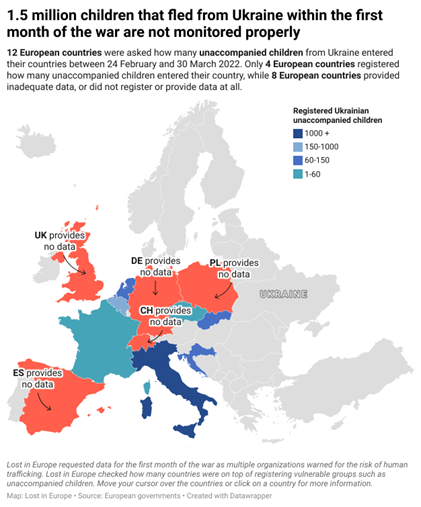
*Click on the image to view the Datawrapper.
In total, we asked 12 European countries (Belgium, Croatia, Czech Republic, France, Germany, Italy, the Netherlands, Poland, Slovakia, Spain, Switzerland, the United Kingdom) to provide us with the requested data. Of those countries only 4 (Belgium, Czech Republic, France and Italy) registered how many unaccompanied children entered their country, including data on age and gender. Three other countries (Croatia, Slovakia and the Netherlands) registered the number of unaccompanied children, but did not know their age and/or gender.
In total 5 countries did not register any unaccompanied children entering the countries, or, argued that this was confidential. Spain argued that providing these answers would ‘harm bilateral relations’ while Slovakia argued that this was confidential information. The Polish Ministry of Family announced the introduction of an online register of unaccompanied minors from Ukraine on March 22. Two days later, the Children Ombudsman appealed to “all organizations and individuals who have brought or are still bringing groups of Ukrainian children to the country” to report them voluntarily and urgently to the register. By the date of publication, the Polish authorities still fail to disclose the results of the effort to our journalists.
Human trafficking
Other human rights organizations share the worries of Missing Children Europe about the unaccompanied children. Two confirm that our data based on the Netherlands is correct and say that they are worried about the safety of these children. Director-manager Ina Hut of the Dutch organisation CoMensha (the Coordination Center against Human Trafficking) says: “Our worries lie within the unaccompanied children who cross the borders. Parents give away their children to people who travel to the west of Europe out of desperation. In the Netherlands, these children are not always registered, just like adult migrants from Ukraine. It is difficult to get a good view on the problem.’
Multiple countries were not able to provide us with any data on how many Ukrainian nationals were identified as victims of human trafficking or exploitation within the first month of the war. In total 7 of the 13 countries (France, Germany, Italy, Poland, Spain, Switzerland, United Kingdom) could not tell us how many possible victims from Ukraine were identified. 3 countries (Belgium, Croatia and the Czech Republic) had zero cases of possible human trafficking victims within the first month. Slovakia investigated 30 cases of possible human trafficking cases, with a negative result. The Netherlands investigated two cases of sexual exploitation.
A spokesperson of UNICEF says: ‘Any child that crosses international borders must be immediately registered by competent authorities so that they can access the services and support they require. Children are at particular risk – including those who arrive separated or unaccompanied, or who have been evacuated from institutions, boarding schools or other childcare facilities – and must be placed immediately into national child protection systems, given the risks to their safety and well-being. All efforts must be made to immediately trace and establish contact with family members.’
Adriana Homolova
Meer artikelen van AdrianaEmma van den Hof
Meer artikelen van Emma
Monica Lam
Meer artikelen van MonicaSchrijf je in voor de nieuwsbrief
Draag bij aan onafhankelijke journalistiek
Investeer in onze makersGerelateerde artikelen
Lost in Europe 65
Meerdere mensenrechtenorganisaties waarschuwden voor het risico van mensenhandel voor kwetsbare groepen zoals alleenreizende kinderen nadat...
lees verder
VN veroordeelt Frankrijk opnieuw om gebrekkige leeftijdsbepalingen
Frankrijk maakt zich schuldig aan ernstige en systematische schendingen van de rechten van alleenreizende buitenlandse...
lees verder

Rotterdamse wijk Bloemhof oefent met rampscenario’s
Crisisoefening in de Rotterdamse wijk Bloemhof toont: Nederlanders zijn nog onvoldoende voorbereid op een 72...
lees verder