
6 juli, 2021 | Auteur: Geesje van Haren, Liset Hamming, Monica Lam | Beeld: LOST IN EUROPE | Trefwoord: europa
Welcome to our Schengen pushbacks file-blog!
In September 2020, four investigative journalists from Lost in Europe embarked on a journey to investigate the so-called pushbacks of minors at the inner borders of Europe.
Pushbacks in Europe
Since September 2020 there has been a gradual increase in interest by the media and the public in so-called pushbacks at Europe’s border. “Pushbacks” are migrants who are rejected at a border and forced (“pushed”) back to the country from where they attempted to cross.
Current research on pushbacks focuses on Europe’s external borders; for instance the border between Greece and Turkey or between Spain and Morocco. However, for Lost in Europe’s Schengen pushbacks file, we are focusing on pushbacks at the internal EU borders. The Schengen borders. Do pushbacks happen inside Europe as well?
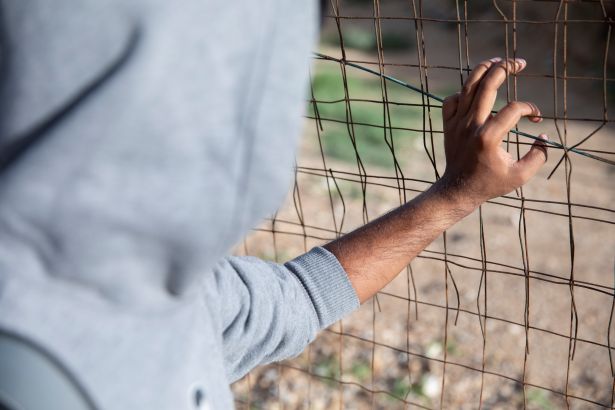
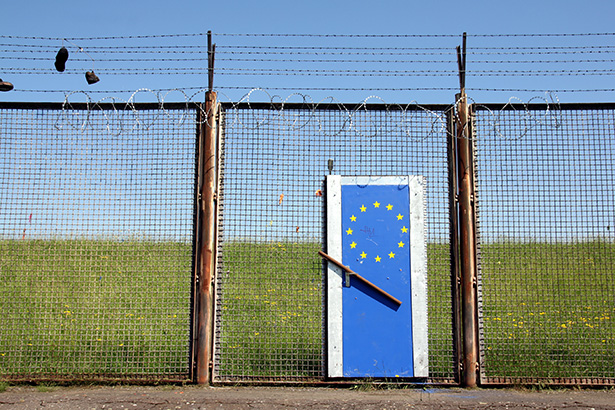 A fence in Hamburg: Symbolic European Border illustrating Europe’s doors are closed. Source: Shutterstock.
Pushbacks of minors are explicitly forbidden by several Child Rights conventions. The United Nations has set out several regulations in order to protect the rights of children worldwide. The basic guiding principle for minors is the principle of the “best interests of the child”. For unaccompanied minors seeking asylum in Europe, this means that the child should be protected and assisted. As stated in the UN Guidelines on Policies and Procedures in dealing with Unaccompanied Children Seeking Asylum, “unaccompanied children seeking asylum should not be refused access to the territory.” The UN Convention on the Rights of the Child ensures that any child who is seeking a refugee status should receive the appropriate protection and humanitarian assistance.
Where to start
During our first brainstorm session in September, we met outside in a sunny grassfield in Amsterdam as the COVID-19 restrictions in The Netherlands were still in place. We asked ourselves: “Who is doing these pushbacks?” and “What documents are kept on pushbacks?” We shared what we already knew about pushbacks of minors at Europe’s inner borders. One of our investigative journalists shared her experiences about the French/Italian border and the French/UK border.
For Lost in Europe Geesje van Haren had visited several locations where unaccompanied minors have gone missing in Europe. She identified key junctions along the refugee transit routes, tracing the journeys from Sicily north to Rome, onwards to the Ventimiglia/Menton border in the South of France before heading to the infamous port of Calais and Dunkirk and then to the UK, many refugees’ desired end point. In the forests, where migrants cross the border illegally, Geesje found documents. Torn paper from court orders, official rejections, and arrests. In Bladel in the Netherlands, in Ventimiglia in Italy and in Calais and Dunkirk in France, she collected these dirty, wet, smelly pieces of paper and dried them on the heater at home. These turned out to be the documents we had to look for by making use of our right to ask for public information.
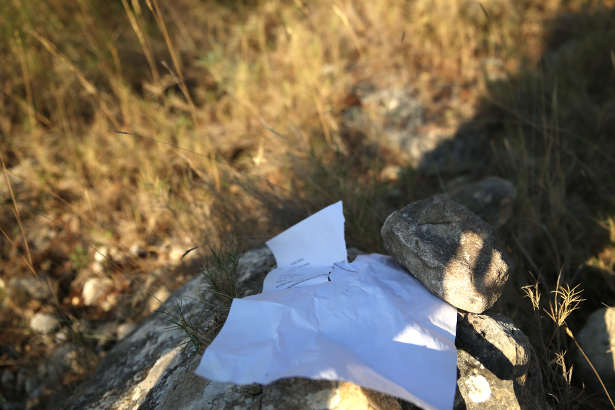 Document with contactdata for migrants who cross the border illigaly via El paso del morte, the path of death in Ventimiglia/Menton. Foto: Geesje van Haren
In addition to this fieldwork puzzle, we analysed the reports published by grassroot Non Governmental Organizations (NGOs), mostly literally sitting in grass next at or near European borders:
Pushbackmap.org
The pushbackmap documents pushbacks on a map. It collects NGO, activist and media reports and places them on the location of the reported pushback.
Border Violence Monitoring Network
The Border Violence Monitoring Network publishes monthly reports of pushbacks along the Greek and Balkan route. These include testimonies, pictures of injuries, medical documents and detailed descriptions of the violence.
AIDA Country Reports
The Asylum Information Database (AIDA) is a database managed by the European Council on Refugees and Exiles (ECRE). They collect information on asylum procedures across 23 countries, including 19 countries of the European Union. In their annual country reports, they also collect pushback cases and the related legislation of the specific country.
There were only a few documents that we could find in the reports gathered by NGOs, sometimes photocopied by the NGOs after interviewing pushed back migrants. But a few is more than nothing and we wanted to know how many of these documents exist. Then our first thought was: let’s ask the national authorities responsible for issuing these documents for all of these documents.
Our methodology
This meant using a method that all four of us were more or less familiar with, although only in The Netherlands: our right to ask for public information. Asking for information at public authorities based on national and European freedom of information (FOI) rights, is a way of gaining public information that is not public yet. It is not a journalistic right, it’s a right that anybody and everybody has. And we took this right to the next level by requesting information from sixteen European countries: Austria, Belgium, Croatia, Czech Republic, Denmark, France, Germany, Greece, Hungary, Italy, the Netherlands, Norway, Slovenia, Spain, Sweden and the United Kingdom.
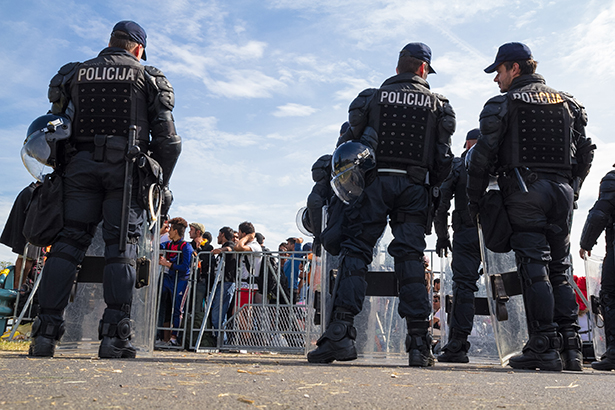 Policemen behind the barrier dividing group of immigrants and refugees from Middle East and North Africa at Harmica, state border between Slovenia and Croatia, 2015. Source: Shutterstock.
National rules regarding the procedure for requesting public information vary from country to country. In some EU countries there are many rules and formalities that have to be borne in mind when requesting public information under the penalty of the request being rejected, like in the Netherlands. Other EU countries do not even (yet) have national laws regarding the process at all, as is the case for Austria.
We will write more about these different FOI procedures in our next blogs.
Since we literally found documents at the borders and found a few documents via NGOs, we figured starting with asking the national authorities of these countries (Slovenia, Italy, France and Germany) for these documents first. Luckily, we found fellow investigative journalists in these countries prepared to help us. Within a couple of weeks we learnt that these documents, apart from one document called ‘refus d’entrée’ found at the French border, were too random to ask for. So we had to think about: what exactly do we want to know?
Which public information can tell us more about Schengen pushbacks? And in what documents can this information be found? Because using our FOI right means asking for public information that is written down in documents.
Together with FOI experts and investigative journalists in all of the different EU countries that we decided to ask for information, we decided to ask for:
The total number of (military) police reports, statements, charges and/or minutes regarding checks, searches and/or arrests at or near the border.
Accompanied with some, specific data among which most importantly: the age of the person stated these documents.
Unaccompanied minors
The investigative projects of Lost in Europe focus on unaccompanied minors. For the Schengen pushbacks file, we therefore focus on migrants under the age of 18 who are not accompanied by a parent or guardian.
Many (unaccompanied) minors in Europe succeed in asking for asylum. According to Eurostat, the statistical office of the European Union, 13,600 asylum applications in the EU were made by unaccompanied minors in 2020. During the ‘migrant crisis’ in 2015, even 95,205 unaccompanied minors applied for asylum. However, there is still a relatively large group of migrants who are left by the wayside. As they are rejected at Europe’s inner borders, sometimes even multiple times, they are still waiting to lodge their first asylum application.
As these unaccompanied minors are in a vulnerable position, their rights are protected through several regulations. For instance by the UN Convention on the Rights of the Child that declares the provisions on the best interest of the child (Article 3) and the special protection of unaccompanied minors (Article 20).
Article 3 and Article 20 also guarantee the right of a procedure to be identified as an unaccompanied child. In some pushback cases, however, unaccompanied minors are denied access to a country without being asked a single question about their age. This was for instance the case when a child was pushed back from Melilla to Morocco.
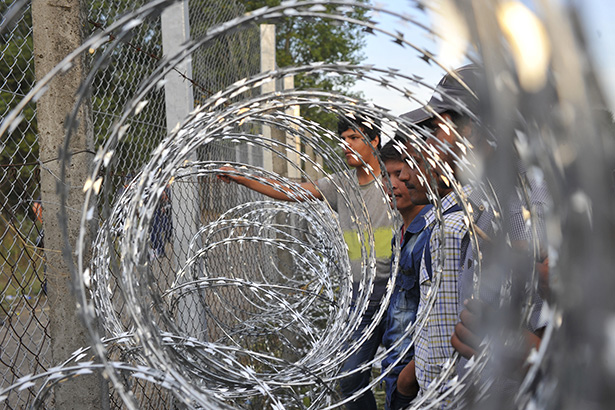 Hungary closed its border with Serbia after the entry into force of the law for anyone who tries to illegally yarn. Migrants in the “no man’s land” on the border crossing Horgos, 2015. Source: Shutterstock.
According to the Parliamentary Assembly of the Council of Europe, pushbacks at the EU borders are ‘at least in part a consequence of the shortcomings of the current Dublin Regulation’. The Dublin III Regulation (2013) determines which EU country is responsible for the asylum procedure. It means that the country through which the asylum seeker first entered Europe, is responsible for processing their asylum application. However, Dublin also provides exceptions for unaccompanied minors. For instance, if the minor has a family member in a different EU country, the child must – after an investigation – be transferred to that Member State. Moreover, the Court of Justice of the European Union (CJEU) ruled that an unaccompanied minor has the right to make a choice of which EU country to apply for asylum. This is even the case when the minor has already applied in a different EU country. According to the CJEU, the best interest of children should be respected.
All these regulations on paper mean that unaccompanied minors cannot be rejected at EU borders when they apply for asylum. In practice, this is however not always the case. Several NGO reports, which we go further into in our upcoming blogs, describe examples of accusations of border guards and police officers pushing back minors at the border, while declaring that the minor is above the age of 18.
15 EU countries and the UK
In the past 6 months we sent our FOI request to 13 different European countries: Austria, Belgium, Croatia, Denmark, France, Germany, Greece, Italy, the Netherlands, Norway, Slovenia, Sweden and the United Kingdom. The requests for Hungary, Spain and Czech Republic are almost ready to be filed.
So why these countries?
Step 1
Our investigation started simple: with a map. As not all EU countries are Schengen countries, we needed to make a clear division between countries that are part of both the EU and Schengen.
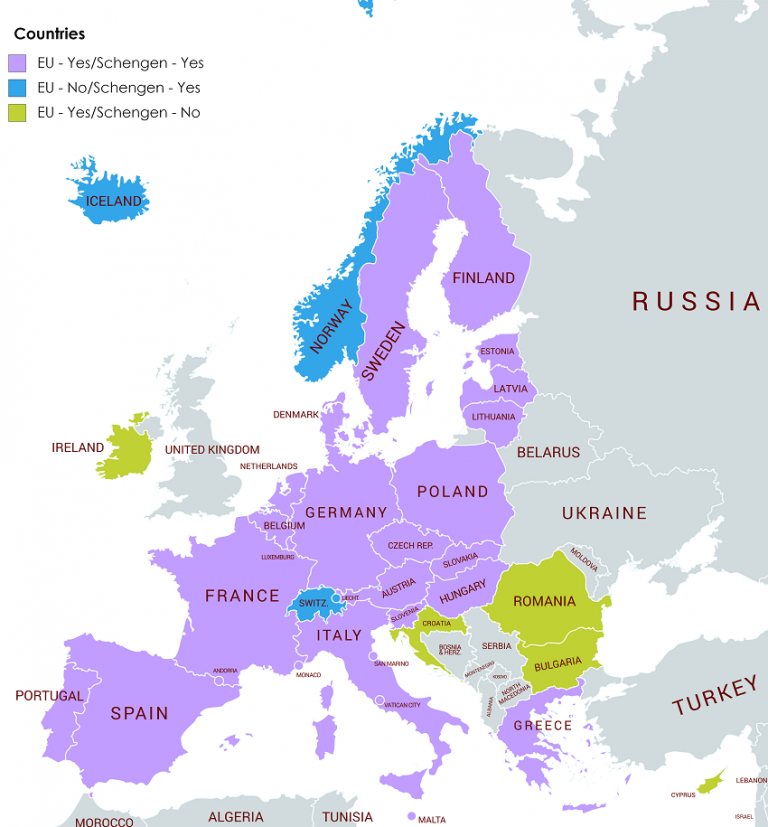
Source: Schengen Visa Info
Step 2
Our second step was analysing the several NGO reports and initiatives that already reported on pushbacks inside Europe which we also used for determining what documents we are looking for as explained earlier.
Step 3
After analysing a selection of these pushback reports, we discovered a specific route. Pushbacks happen between Slovenia and Italy, between Italy and France and between Italy and Austria.
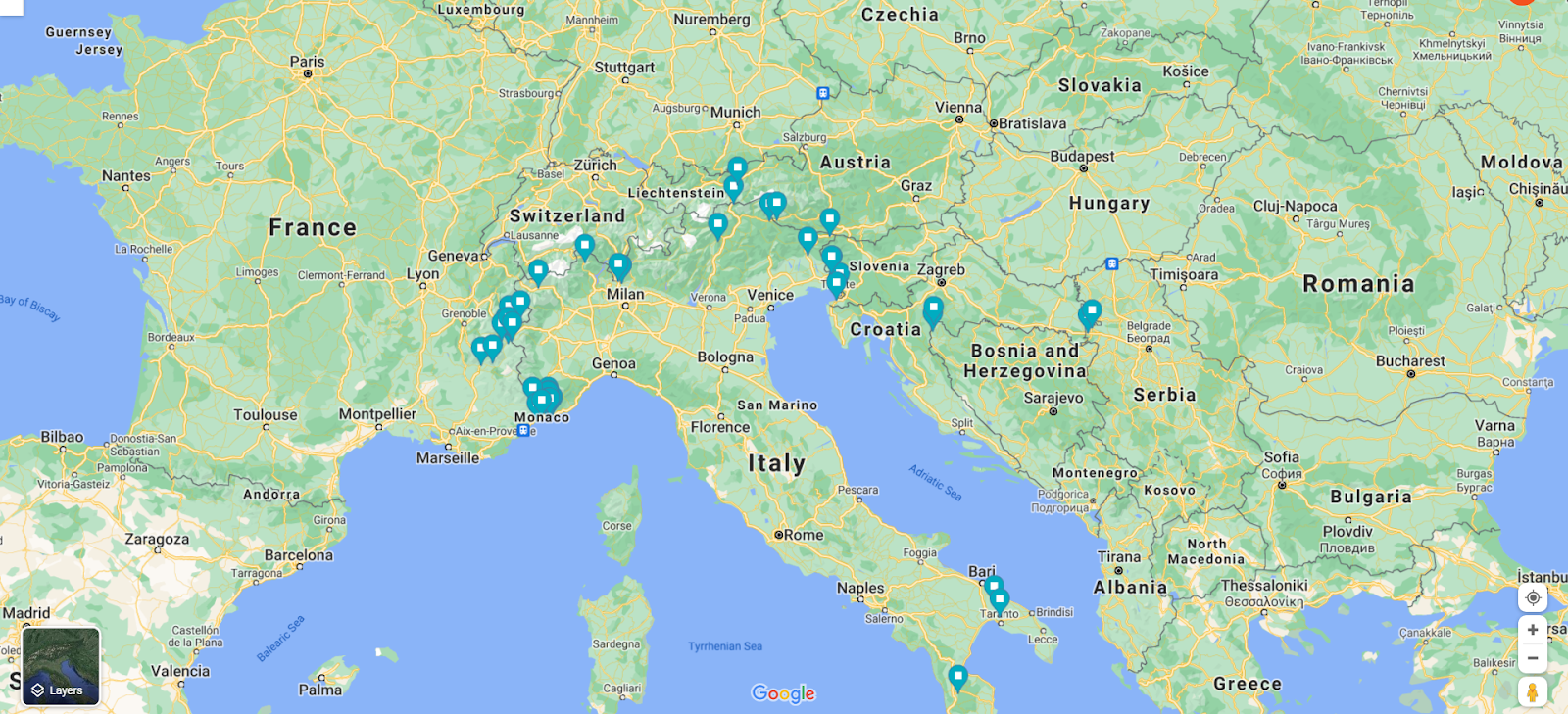 Map made by Monica Lam.
Step 4
With this map on our minds, we made our first couple of FOI requests that were based on this route. However, requesting information from public authorities in Schengen countries is not that simple. Austria does not have a FOI regulation. Denmark asked us: “What is a FOI request?”. We tackled our own prejudices, especially with regard to the laws in Scandinavian countries. Along the borders between Italy and France, where pushbacks happen on a large scale, the police appear to not know their own regulations. And on the complete opposite, we have Hungary that proudly publishes a daily overview of pushbacks along their borders.
These examples are only the tip of the iceberg. These, and more examples, will be presented in our next blogs as will take you along our encounters with these 16 European countries.
Lost in Europe
We are Liset Hamming, Geesje van Haren, Adriana Homolová and Monica Lam, investigative journalists of Lost in Europe. Lost in Europe is a cross-border journalism project investigating the disappearance of child migrants in Europe. Lost in Europe discovered, during a two-day online bootcamp with requested data from 30 European countries about missing children, that between 2018 and 2021, more than 18,000 migrant children went missing in Europe. The goal of Lost in Europe is to recover the stories of these missing children. It comprises a team of 24 investigative journalists from 12 European countries, who are collaborating to find out what has happened to the disappeared children in Europe.
Geesje van Haren
Geesje (1980) is afgestudeerd aan de Hogeschool voor Journalistiek en rondde vervolgens de deeltijdstudie aan de Fotovakschool af, waar zij zich specialiceerde in Nieuws- en Documentairefotografie. In 2005 richtte zij VersPers.nl op. Een training en publicatie platform voor journalisten.
Meer artikelen van GeesjeLiset Hamming
Meer artikelen van Liset
Monica Lam
Meer artikelen van MonicaSchrijf je in voor de nieuwsbrief
Draag bij aan onafhankelijke journalistiek
Investeer in onze makersGerelateerde artikelen
Verkeerd medicijngebruik
Jonge migranten die kampen met trauma’s, taalbarrières en gebrek aan perspectief raken op straat en...
lees verder

Europe’s growing appetite for avocados
On a busy canal-side street in central Amsterdam, the world’s first avocado-themed restaurant
lees verder
Lost in Europe 75
Georganiseerde criminele netwerken halen
lees verder