
31 oktober, 2022 | Auteur: Marlies Rothoff | Trefwoord: lost-in-europe-summerschool
An old Palermian ‘problem’
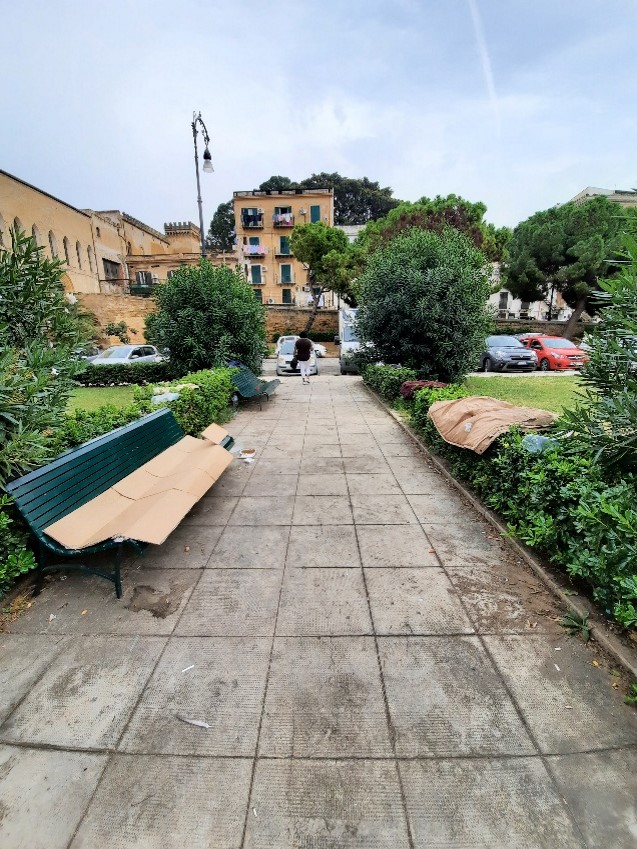
Under the old, static city gate at the port occurs an old Palermian sight. Homeless migrants who seek shelter underneath it. Hundreds of migrants are still arriving daily by boat on the Italian islands in the Mediterranean sea. In January alone more than 2347 people (infomigrants.net) made the dangerous crossing and set land in Italy. But after they get out of the vessels alive, the next struggle begins: finding your place in Italy or another European country.
Jenny (41) who’s a migrant herself, but is in Palermo for 34 years now, points at a guy who’s sleeping in a corner inside of the busty gate. Covered in vague red and yellow blankets, you have to walk past him to see him. In the small openings in the walls you find all kinds of personal belongings. Dry blankets, shoes and carboard boxes are stuffed in the small nooks.
Jenny looks sad when she tells that people actually sleep in there, standing, when it rains. She knows the guys around the old gate. She comes often to help there as a volunteer, giving them food and blankets. Jenny: ,,I didn’t have any help when I came here, so I know how it feels. I don’t want them to feel that way. Still, I think their situation is far worse than mine ever was.”
A different group
She’s shaking her head before walking further, explaining how the city works for migrants. She knows that all too well. Even after 34 years, she has no Italian passport and struggles everyday with permits and income. But, she thinks she’s luckier than the people who are now arriving in the city. ,,At least I got a chance to build something. It was hard, but there was less bureaucracy and less rules too. So by hard work, I could get at a point that I kind of belong in the city now.” Even though she still gets the feeling that a lot of Italians see them as second range citizens.
She explains where that sentiment comes from in her opinion: ,,Migrants are seen as one group of people by the Italians. But to be honest, migrants have changed over the years too. A lot of migrants who arrive now have a different attitude than the people who arrived in the eighties. That’s the time I arrived. Some people now think they are obliged to have the same rights as all Europeans have. They kind of demand shelter or houses, money, work. Sometimes people in Italy think it’s arrogant. And that’s the way they look at all of us. No exception.” She nuances that of course everybody has a right to find a home, have a job and need money to come round. But that some migrants now seem to think that it is a thing you can just get in Italy or Europe, without doing much for it. While the system that exists in Palermo asks to also do a lot of work yourself.
Not only the shift of attitude is changed, but also the situation migrants arrive in when they come to Palermo. For instance, now there are a lot more refugees than in the eighties. Jenny explains that, when she arrived, there were not many migrants. Just a few groups like the Bangladeshi’s, a few people from Mauritius (like she is) and a few Africans. Since the mid nineteen-nineties, there are way more Africans arriving. Since this moment, migration, refugees and the migrationsystem have changed according to Jenny.
At the terrace of a little cafe in her old neighborhood Ballaro, where still a lot of migrants live next to a great deal of poor Sicilians, she starts telling her story and how she, the early migrant, got to Palermo and found her ways around the city. She wants to tell about differences, but also about the problems that still exist.
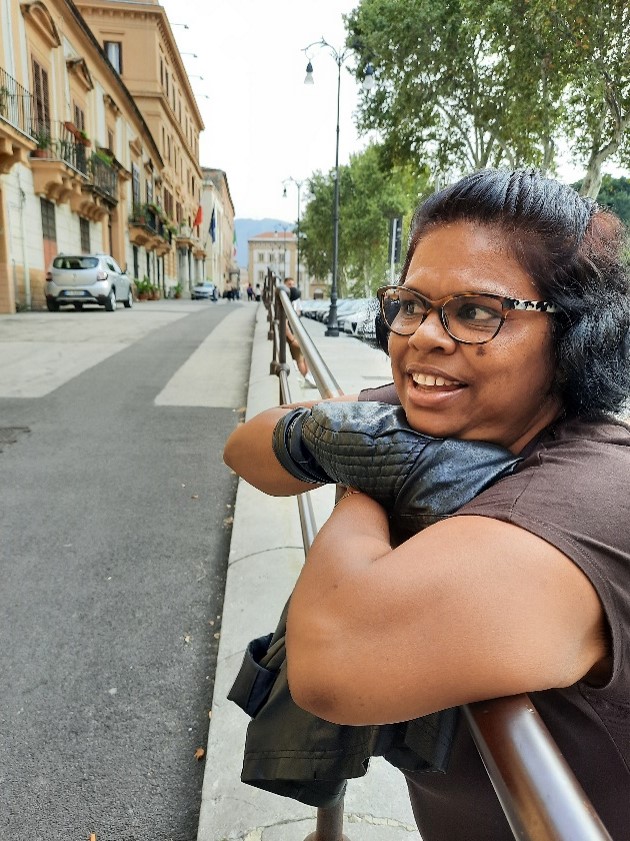
‘A long way’
,,I was seven when I got here. I come from Mauritius. The island was poor at that time, but it was okay. It was because my grandmother decided that she wanted to go somewhere else. We followed her to Sicily. When I was small, she was always supporting me. I dare to say that she was kind of my best friend when I was young. So when she left for Italy to work there, she missed me. She called my mom to say that she wanted to bring me over. My mom wouldn’t let me go on my own, so she bought a ticket too. My sister and brother were also coming with us. Only our dad got to Palermo nine months after us.”
Jenny tells it was a long trip. It took them three days, a few nights at airports and three plains to get to their new city. ,,But I am still happy we got there by plain. When you see migrants now, arriving by boat or in a dingy, not sure if they arrive alive. That’s heavy. We had something to look forward to, knowing our grandma was there to take care of us.”
After three days, Jenny, her mom, sister and brother arrived at the address where their grandma worked and slept. The elderly couple she worked for, said that the family could stay there for one day. After that, they should find something for themselves.
,,The next night we slept in the elevator of that building. Moving out every time someone had to use it. It was very hard. After that day my mom and grandma went searching for some place to stay. At first it was with this African lady who just wanted to take care of the three of us children. She made us sleep on the floor, without blankets. It was cold, because it was October when we got there.”
In a few weeks they had their first house. ,,It was an old house in Ballaro. It had no bathroom. So we had to wash ourselves in the kitchen sink and when we needed to go to the toilet, we had to go to the neighbors.” She laughs. It was not much, but it was a beginning.
No social service
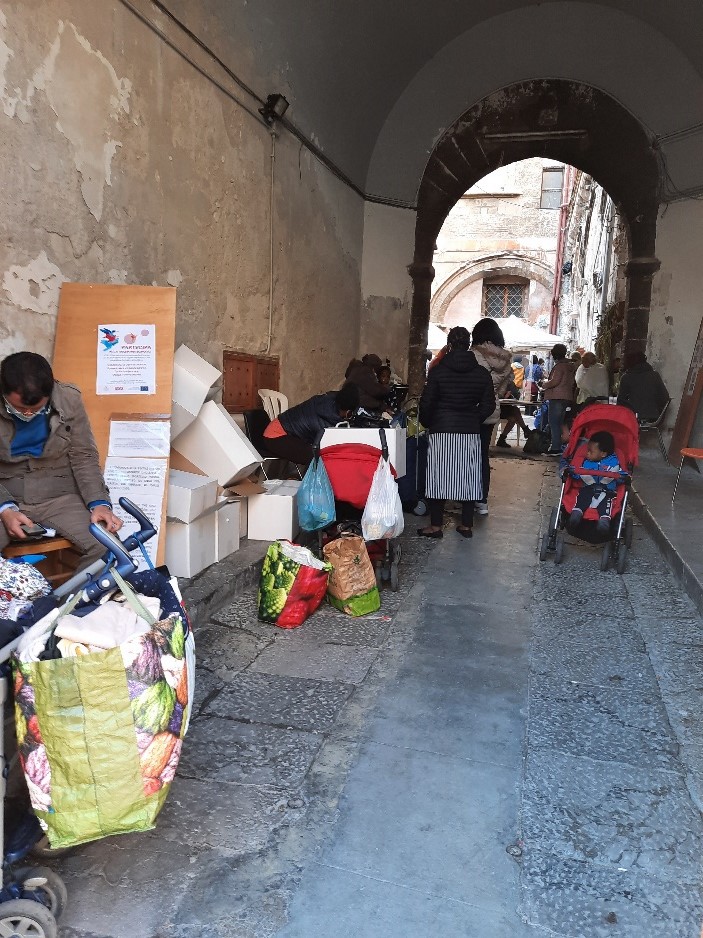
She tells that in the nineteen-eighties there was no such thing as a social service which would take care of you and your family. ,,There was no one there to come check if your family was alright, there wasn’t even as much charity like there is now. Now you have all those centers who give out breakfast, food packets, clothes. You can even take a shower there. And if you really have no place to go, you can sleep there. Centro Astalli (see picture) is an example of that, it is one of the eldest refugee centers in town. Besides that you also have Porco Rosso, where the people will help you with any legal and paper work. And a lot of churches hand out food and other stuff on certain days.
When we arrived we had to live off the charity of the people we met. We had to build our own network. There wasn’t even an migration office. No one checked if you had papers. You just had to blend in to get a job for example. Learn the language yourself and go.” For Jenny this situation is still a reason to help migrants now. She doesn’t want people the way she did in the beginning.
Because even though there is much more help for people in need; the centers, the way the municipality checks in with you and your family and tries to provide enough for anyone who arrives at the city, doesn’t seem enough for the many people who arrive in the city daily.
Salvini
Palermo doesn’t seem to have the capacity she used to have before 2015, the year Salvini came to power in Italy. He was a rightwing president who tried to handle the big number of refugees by ‘scaring them off’. Jenny tells he cut off carefunds and funds for the municipalities which money was meant for refugees. Lots of refugee centers closed their doors. So lots of refugees landed in the streets of the city or in camps around Palermo.
Jenny speaks of the consequences she sees every day. She’s a translator for refugees at the court in the city, she helps at centers and churches where they provide food, clothes and beds. And she also tries to help the homeless people at the city gate.
She talks about the African and Bangladeshi migrants who still arrive every day. She feels for them. ,,Life is hard in Palermo for migrants. It’s hard to keep going for many of them. Those people have to live off charity or the scraps that society gives them.” Jenny thinks some people just take it for granted, the charity and the scraps. ,,But a lot of migrants just don’t know a way out of this system. See, in order for you to stay in Italy legally you have to have schooling to get a normal job. And of course you have to speak the language. You get a lot of opportunities to get this right when you get to Italy, but they only give you 2 years to get your language straight and find a job. Most people who arrive don’t have schooling though, or are illiterate and end up doing hard labour on olive farms just to earn enough money to get round.”
Palermitans
Jenny doesn’t think the system is fair to the people who arrive newly in the city. Because after the few years they get, they have to do everything by themselves. ,,There’s not enough time to learn the language well enough and do some extra studies to eventually find a job. And jobs, well, there are not many of them either.” She adds: ,,You know, then-mayor Leoluca Orlando once said that all people in Palermo are Palermitans. Thus equal. But it doesn’t feel that way. There are a lot of different rules when you don’t have an Italian passport. You’re checked upon a lot. That’s where the permit comes in. But if you ask for a permit, it takes nine months to actually get it. The permit lasts for a year, so you have to ask for it again around the time you finally got it. In the meantime they give you a receit. A little piece of paper what is actually your permit. You have to have that with you, to show you’ve paid for a permit, for when they ask for a passport. It’s a process you need to be persistent. But you also have to be smart and know the rules. Not everyone can cope with that.”
She’s shaking her head while telling it. ,,Without the receit, you can’t do anything. You can’t go anywhere, you can’t work or live. There are centers where you can sleep at night, but those are full. You’re kind of pushed on the street if you don’t have a permit and try to survive in the way the street teaches you to. Without a permit you also can’t go back home. So you get stuck.”
The grey area of Palermo
Stuck in a grey area. Jenny points down the street in Ballaro and starts whispering. ,,Police will never get here, in this neighborhood. There are different rules here, if you want to put it that way. The rules are made by some families, you could describe as mafia. It’s a way many refugees survive.”
In Ballaro there is this big mural of San Benedetto il Moro. He’s watching over the migrants in the area. A protection they need. The mural is found behind the famous Ballaro market at a little soccerfield where a few boys are playing. There’s garbage all around. ,,That’s because of the market. They don’t clean it. And because the police and municipality don’t come here, it’s a mess.” She starts pointing out other things in the streets and at the square which tells us more about how this area works. A school without any students or classes. The old houses.
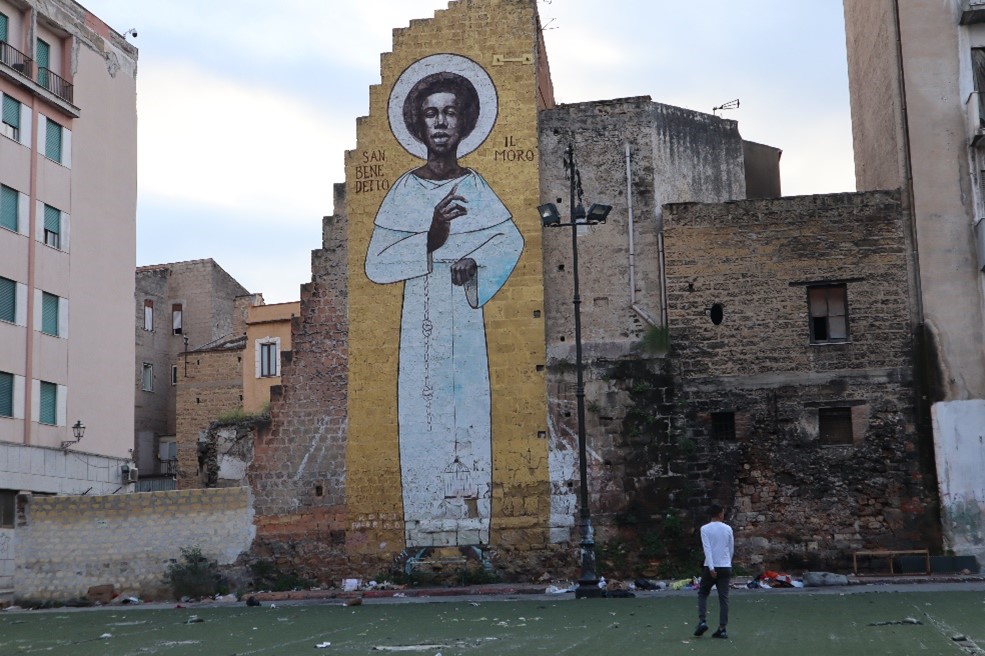
A lot of migrants start their own shop here, that is when they have their permit and can start with their lifes in Palermo. ,,There is an opportunity to do nice things here. But there is also another kind of migrant in Ballaro, who are in the grey area I talked about. There are a lot of illegal practices over here. Like selling drugs or illegal cigarettes. It’s a situation a lot of migrants get stuck in. Because it’s an easy way to get money, but half of the time the people who sell or deal are also addicted.”
And from that place on, you can only go down. Jenny thinks that there are too many people arriving to have a good view on the problem and the number of people going down in this gray area. Especially after 2015 and the Covid-19 pandemic. Those events seemed to be the last blow for the welcoming vision towards migrants. Now people get lost in the streets.
,,Even though all those nets are actually there to catch people, it isn’t enough. It’s also the way people look at migrants, and like I said before: we are not seen as equal to most Italians here. After 34 years I still have problems with my permit, but at least I have a home, education and a job. It took me a lot of years to get here, but I got the chance eventually. When I see migrants now they have not much to live for. If they don’t have an education or not enough work short after arriving, they’re doomed to live off charity. Or worse. You end up like the men at the old gate. Drunk in the daytime, to forget about life. And afraid of the dark.”
Jenny keeps doing her voluntary work. She doesn’t know if things will get better for refugees in the city in the years to come. ,,If the country swings to right-wing politicians again, I don’t have high hopes for them.”
Gerelateerde artikelen
Een taart, net als vroeger
Deborah vierde op 18 december 2020 haar 18e verjaardag in het asielzoekerscentrum in Arnhem. Op...
lees verder
Geen ouders meer nodig
Emilia woonde bij haar oma in Brazilië op de dag dat ze 18 jaar werd....
lees verder
Ik doe dit ook voor mijn broertje
In het appartement in Rotterdam stond een klein slagroomtaartje. Qianlei blies de kaarsjes uit in...
lees verder