
7 november, 2022 | Auteur: Coen Ramaer | Trefwoord: oekraine
A warm welcome, for white Ukrainians
Europe welcomes millions of Ukrainian refugees with open arms. But people of colour fleeing the same war face all kinds of discrimination. “Everyone must now recognize that Europe has a problem with institutional racism”
Patience (21) grew up in Ghana but last year she studied in Sumy, a city in the northeast of Ukraine. She survived Russian bombings, sat on the ground for sixteen hours in a crowded train to Ternopil, and spent three months hoping in vain for a place at a Hungarian university. Then she moved to the Netherlands. When she arrived at Utrecht Central Station, she asked for help from a blond woman who turned out to be Joanna. Together they went to the Humanitarian Service Point.
Once there, a volunteer in a green vest offered Joanna a chair. Patience, still exhausted from her long journey, wanted to grab one too. “But the volunteer turned to me and said, 'No, you stay,'” says Patience. “I froze.”
Then the volunteer offered Joanna tea and coffee. But when he turned to Patience, the friendly look on his face disappeared. He only offered her water, says Patience. Joanna confirms her story.
“When the volunteer went through my passport, he said, 'No, this isn't right,'” says Patience. "He said there was a recent change in the rules that prohibited him from helping me." Patience didn't understand this. She had read a message from the Red Cross stating that she could still receive help at the post at Utrecht Central Station. “I wanted to show the message but he waved my phone away,” says Patience. “He said, 'Even if the message is from the Prime Minister himself, I can't help you. The policy has just been changed."
Patience was lucky. Joanna's parents were able to take her in. But her experiences in Utrecht have not left her in the cold. “Of all the things I've experienced in recent months, arriving in the Netherlands was the worst,” she says.
The reception of Ukrainian refugees can count on much praise throughout Europe. Never before have Member States responded so quickly and efficiently to the influx of millions of displaced people. But where white Ukrainian refugees can often count on a warm welcome, a house and a job, the reception of people of colour fleeing the same war is a lot more grim. “Every person of colour experiences at least one form of discrimination during a flight,” said Nora Brezger of the Berlin Flüchtlingsrat, an organization that campaigns for refugees' rights at the regional level.
Ukrainian customs authorities pulled refugees of colour from buses and trains to make way for 'real' Ukrainians. On the border between Poland and Ukraine, displaced persons of colour had to wait for hours in the freezing cold while white Ukrainians were given priority. Once across the border, they were ignored by Polish volunteers who drove only 'real' Ukrainians to Warsaw. And in the Polish border town of Przemysl, far-right groups attacked refugees of colour.
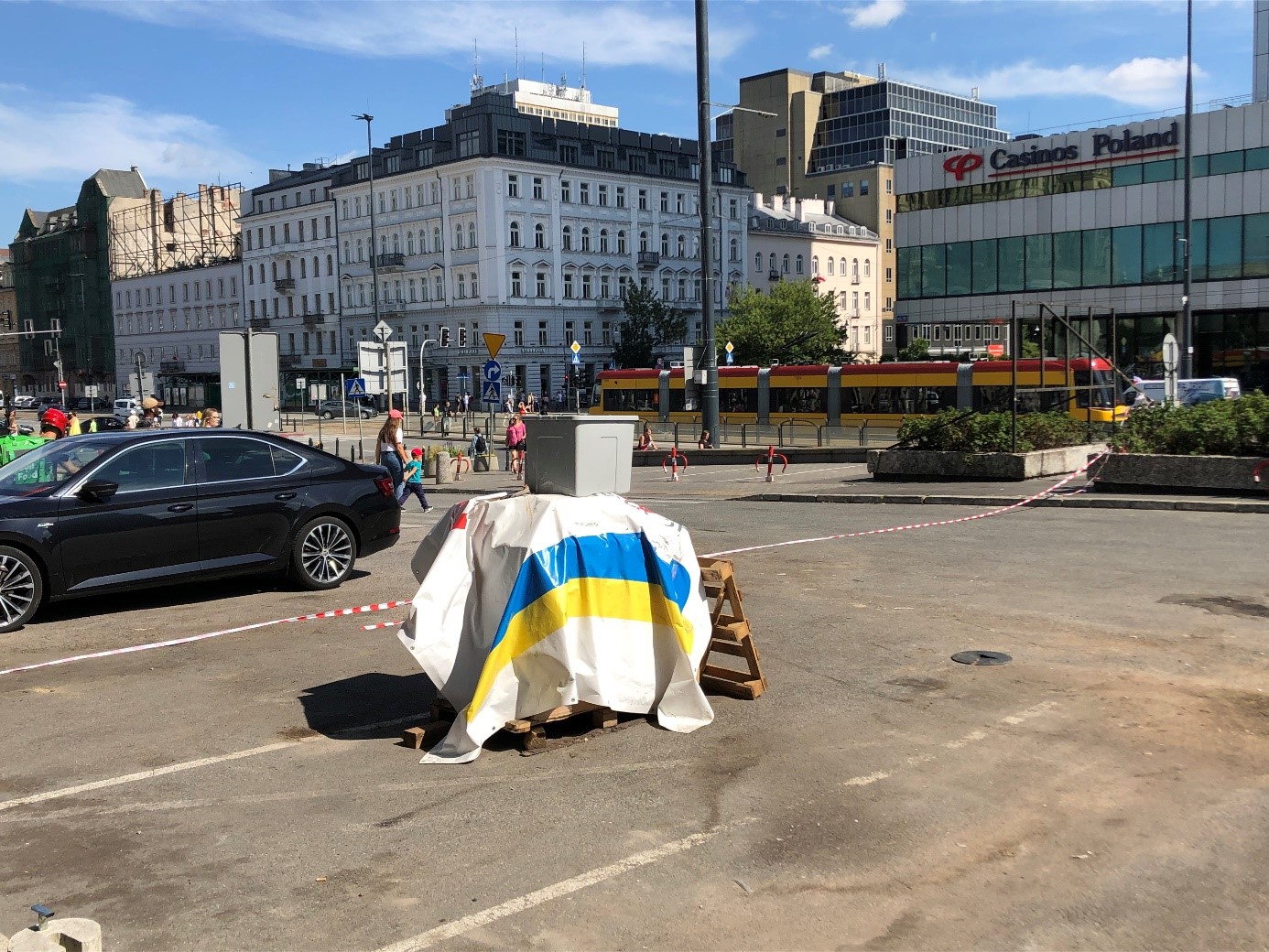
The Gates are Closing 1: Warsaw, August 1, 2022. Last remains of the reception tent for Ukrainian refugees at the central station. Most third-country nationals continued their journey because they are only allowed to stay in Poland for 15 days.
According to Nora Brezger of the Berlin Flüchtlingsrat, employees of the immigration service in Berlin took the passports of at least twenty Ukrainian refugees of colour and then forced them into a regular asylum procedure. In at least thirty cases, the German social services refused to give refugees of colour the living allowance to which they were entitled. Accommodation was difficult to find, partly because German host families indicated that they did not want to accommodate refugees of colour.
That also happens in the Netherlands. In the month of July alone, the Red Cross registered four cases in which a host family indicated that it did not want to receive Ukrainian refugees of colour. NuTwente, which coordinates the private reception of 357 Ukrainians, also experienced this several times.
But aren't they all incidents? “No”, says Henk van Houtum, professor of Political Geography and Geopolitics and expert in the field of European migration policy. “It is clear that the EU's border policy discriminates on the basis of origin, and therefore also between refugees. In 2001, the EU created two lists of visa-free and visa-required countries. Citizens born in the mostly poorer countries, and indeed more often with dark skin, are subject to a visa. People born in the usually richer countries are visa-free.”
With these lists, the EU creates a paper border that is actually much more intrusive and tougher than the iron fences and stone walls that the EU builds, explains Van Houtum. “It ensures that a refugee born in Ukraine, which is on the visa-free country list, can travel unimpeded and legally to the Netherlands, while a refugee from, say, Syria or Eritrea can usually only cross the Mediterranean with the help of smuggling services. And it is that distinction that leads to chaos, the illegal push back of visa-required migrants and, how disgraceful, the now tens of thousands of deaths at the border."
“The current visa policy is therefore a form of nativism,” says Van Houtum. ‘How free you are in your global freedom of movement, and with it your rights and dignity, is determined on the basis of where you were born: the lottery of birth. This is contrary to the spirit of Article 1 of our Constitution and Article 1 of the Treaty of Lisbon of the EU, which prohibit discrimination based on descent, as well as Article 1 of the Declaration of Human Rights, which states that all people are free and equal in dignity and rights are born. In other words, the EU uses institutional apartheid in its border policy, in violation of its own constitutional state. The EU thus makes discrimination, xenophobia and the erosion of human rights, which it says it fights against, acceptable. With all its consequences.''
Street sounds are silenced in the invisible cloud of heat that sweeps through Berlin. It's 37 degrees. "With temperatures like this, I'm worried about all those refugees who can't get health insurance because of their separate status," says Vicky Germain, while text messages are constantly pouring in on her phone.
Vicky Germain is a project manager at the CUSBU project and, together with a number of other NGOs, runs a community centre for people of colour fleeing the war in Ukraine. If you want to visit the house, you don't have to ring the bell: the front door is wide open. Inside, three young volunteers have the utmost fun with each other, another stares intently at a sheet of paper, and yet another volunteer mumbles sounds of agreement as she picks the wire of her iPhone earphones. In total, about twelve hundred volunteers are involved in the projects of CUSBU. “People can come here for advice, a hot meal and just to have fun,” Germain explains, showing the kitchen and garden. “We were lucky. In April, another NGO decided to fund us and in July we received state funding for the community centre.”
Germain is a seasoned activist for children's and migrants' rights who, among other things, was there when refugee numbers from Syria peaked in 2015 and 2016. The moment the war in Ukraine broke out, she immediately realized that refugees of colour were an extra vulnerable group. Together with a number of other Berlin organizations she decided to help.
Not only did she hear many stories about racism, she also saw that refugees of colour ran into a paper wall everywhere. Most of them were students and had temporary residence permits for Ukraine. They fell outside the separate arrangement that many European member states made for Ukrainian refugees shortly after the war broke out. For example, they were subjected to cumbersome asylum procedures, while refugees with permanent residence permits were given quick and easy access to a house, living money and health insurance. Even Ukrainians of colour with permanent residency were treated differently from their white compatriots.
That different treatment also made Vicky Germain concerned about herself and her team. She has lived in Germany for almost twenty years but is originally from New York. She wondered what would happen if Putin made it to Germany? “At least I could flee to America and continue my work there. I held my breath for all my colleagues who did not have that option.”
|
Foreign Students in Ukraine When the war broke out, more than 75,000 foreign students were registered in Ukraine. Al Jazeera found that most students come from India, followed by Morocco, Turkmenistan, Azerbaijan, Nigeria and China. Ukrainian universities are relatively cheap and offer good quality education. Moreover, it is possible for foreign students who start work in Ukraine to obtain a permanent residence permit. Foreign students first came in large numbers when the Soviet Union tried to improve ties with Third World countries in the 1950s. After the fall of the iron curtain, their numbers dwindled. But in the past three years, the Ukrainian government has recognized that there is a lot of money to be made from foreign students and established the Ukrainian Government Center for International Education, tasked with attracting foreign students. |
In almost all of Europe, refugees with a Ukrainian passport, more often with a white skin, are given the opportunity to circumvent asylum procedures through a special protection directive from the European Union. They gain access to all basic amenities surprisingly quickly. This special treatment usually is not given to refugees with a temporary residence permit from Ukraine, more often with a darker skin color. They have to apply for asylum, are not given access to basic facilities and are thus forced to sleep outside in places like Ter Apel. In so doing the European policy towards Ukrainian refugees echoes the apartheid in the general European refugee policy.
Until the 19th of July, the Netherlands was one of the countries that unconditionally accommodated refugees from Ukraine with a temporary residence permit. But it changed its policy for two reasons. First of all, the Ministry of Justice and Security has received signals of abuse from various Security Regions and municipalities, says State Secretary for Justice and Security Van der Burg in a letter to the House of Representatives. But a spokesperson indicates that the State Secretary cannot specify exactly how many signs of abuse there were and whether they actually turned out to be correct.
The second reason for changing the policy is the fact that people with a temporary residence permit can often return safely to their country of origin, according to the State Secretary in the same letter. The 22 municipalities in the North and East Gelderland Security Region explained in a letter to the State Secretary that they are afraid of losing support among the Dutch population. “After all, the alternative is just going back home. We would also say the same to our own children if they were overwhelmed by a war while studying or working abroad.”
Fairuz Sewbaks is a lawyer at the PAD Link foundation, an organization that advices and helps Ukrainian refugees of colour. According to her, the reasoning of the Dutch government pays too little attention to the specific situation of students of colour. “Just because someone doesn't immediately end up being tortured when they get home, doesn't mean it's safe for them. Some of them gave up everything to study in Europe. Returning is not an option for them. All they need is temporary shelter so they can go back to their university in Ukraine when the war is over.”
Other organizations are also critical of Dutch policy. “In crisis situations, the government has a duty to guarantee adequate reception to all asylum seekers and displaced persons and must not discriminate in the process,” the Human Rights Institute said in a statement on its website. The Red Cross decided to close its Humanitarian Service Point at Amsterdam Central station because it could no longer guarantee the 'humanitarian'-part after the policy change of July 19, a spokesperson indicated by telephone.
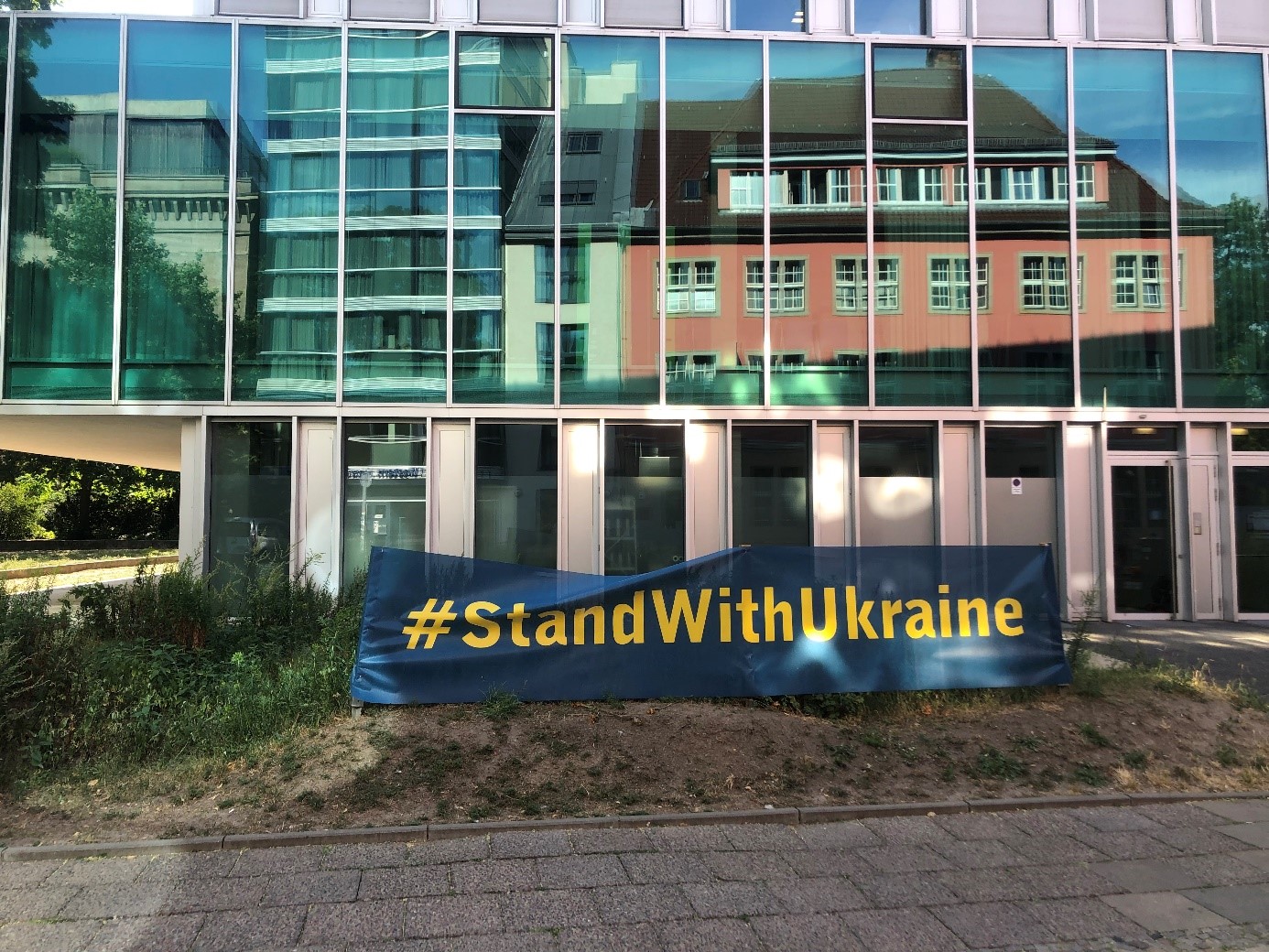
The Gates are Closing 2: Berlin, August 4, 2022. The pink building in the reflection is the Ukrainian Embassy in Berlin. Ukrainian law prohibits diplomatic posts from helping third-country nationals. When refugees with a temporary residence permit did not have certain important documents, they were told at the embassy: “go back to Kiev”.
“When the war broke out, my husband was abroad and I was alone with our baby,” says Precious Ani (24). Originally from Sierra Leone, she had been living and studying in Kiev for three years when the first bombs fell. She decided to flee and ended up in a shelter in Warsaw. “I wanted to work, but a Polish volunteer said I couldn't because I'm not Ukrainian.”
She decided to move on to Germany, where refugees with a temporary residence permit could still count on temporary protection at that time. But in the rush of the flight, she had forgotten her daughter's birth certificate, a necessary document to claim German aid. She went to the Ukrainian embassy. “They told me that they only helped Ukrainians and that I had to go back to Ukraine if I needed anything. They were so unkind. Sometimes they even refused to talk to me.”
Finally, she found herself forced to move back and left her daughter with friends in Berlin. It was raining bombs in Kiev but she survived the trip and found the birth certificate. On the way back she was told at the border with Poland that she was not allowed to enter the country, because she wasn’t a 'real Ukrainian'. She was stopped again on a second attempt. “I started to cry and explained that I had to go to my baby. Some kind of boss was called in and happily he let me through.” Once across the border, she wanted to use the free train services for refugees from Ukraine. But she was told that the free train was only for real Ukrainians. So she paid for a bus to Berlin.
She has since been reunited with her husband and daughter. But her experiences left deep scars. “We paid taxes in Ukraine and contributed to the economy. Yet we are treated differently. I expected the flight to be harder for people like us, but not that it would be so cruel.”
She has applied for a passport from Sierra Leone for her daughter. "I don't want her growing up in an environment that considers her a second-class citizen."
In the end, Precious and Patience could count on help from various groups of volunteers. Driven by shocking videos on Twitter, Instagram and Telegram, people of colour from all over the world sprang into action when the war broke out. But those volunteers also ran into certain walls. “We asked for help from Save The Children, UNICEF and the Red Cross. They were not interested in supporting us financially. There was no help and there is still no help,” said Criney Insalata, who set up an organization from London to help students detained in the Ukrainian city of Sumy. Volunteers Tade Omotosho from Poland and Fairuz Sewbaks from the Netherlands confirm this.
Dutch people donated millions of euros to aid campaigns for Ukraine. 170 million went to the eleven organizations of Giro555. Almost all organizations indicate by e-mail that the fight against racism and discrimination is an integral part of their identity. “Equality for all children is the foundation and starting point of our work,” said a UNICEF spokesperson. Save the Children issued a press release in March calling on European member states to extend their temporary protection directive to all Ukrainian refugees.
Furthermore, several Giro555 organizations refer to a treaty they signed that obliges them to stand up for the most vulnerable. Some organizations offer separate workshops for their employees to arm them against racism and discrimination. Two organizations also have a separate working group to combat discrimination in the workplace.
However, the editors of Small Stream Media also looked at their annual reports from the years 2020 or 2021. These are documents of dozens of pages in which the organizations explain their financial situation, vision and projects. In nine of the eleven reports the word racism does not appear at all. The word discrimination appears in only four of the eleven reports. Only Plan International extensively discusses the importance of the fight against racism in its annual report.
Jeff Kwasi Klein is an expert on racism. He is part of a special committee that advises the local government in Berlin on discrimination and tries to raise awareness with the NGO Each One Teach One (EOTO). For example, EOTO monitors individual cases of discrimination in Berlin and it claims to run the largest library in Germany with literature by black writers. “What you see is that in the discussion about racism we always tend towards an analysis of intentions. Then it is very difficult to prove racism and one often comes to a different explanation for the behaviour of individuals, governments and other organizations. But if we look at the lived experience of refugees of colour in Europe, a clear picture emerges. They have to deal with closed doors, blunt communications and can usually count on fewer rights. That is institutional racism and Europe has a much bigger problem with it than it realizes.”
The Gates are Closing 3: This red and white bear welcomes refugees arriving at Berlin Hauptbahnhof. Next to the entrance to the welcome hall is a sign that reads "Only for refugees from Ukraine!"
A week after the experience at Utrecht Central Station, Patience and Joanna are sitting in a cafe in Utrecht. Tomorrow, Patience will take the Flixbus to Portugal, one of the few places where refugees with a temporary residence permit are welcome. There she hopes to get a quick response from one of the Hungarian universities where she applied. That would legitimize a longer stay in Europe.
Some people advised her not to go to Portugal. Despite the better rules, they are also faster with deportation in Portugal, and her home country Ghana is seen as a safe country. Still, Patience takes the risk. She certainly does not want to go to Ghana. “Even though Europeans see it as a safe country, I can't realize my dreams there. It took me years to get my place at a good university. I had it in Ukraine. When I go back to Ghana I will have wasted at least two years and will have to start all over again,” she explains. Then her breath stops and she has tears in her eyes. “I had hoped that by now I would have a permanent place again.”
Gerelateerde artikelen
Een warm welkom, voor witte Oekraïners
Europa ontvangt miljoenen Oekraïense vluchtelingen met open armen. Maar mensen van kleur die dezelfde oorlog...
lees verder
Frontex blijft zwijgen over contact met Libië tijdens beschietingen op zee
Terwijl reddingsschepen op de Middellandse Zee onder vuur lagen, onderhield het Europese grensagentschap Frontex contact...
lees verder
De onzichtbaarheid van arbeidsuitbuiting in het strafrecht
Een echtpaar uit Cuijk staat terecht voor arbeidsuitbuiting van twee au-pairs. Dat deze zaak voor...
lees verder